
How LGSF Turns Cold-Formed Steel Design Data into High-Output Factory Production
LGSF has grown from early specialist Light Gauge / Cold-Formed Steel projects to a production operation capable of producing over 550 tons of panelized steel systems per month. Behind that growth is more than roll-forming machinery. LGSF has built a connected design-to-production workflow where Vertex BD supports design, detailing, production data, factory assembly, and downstream installation requirements in one practical process.
Case Study:
LGSF
LGSF has been providing solutions in steel for over 30 years in Scarborough, UK
When machinery, people, software, factory knowledge, and buildability process are working together, a Light Gauge / Cold-Formed Steel company can spend less time fighting the workflow and more time on increasing revenue throughout the process. LGSF is already proof of that: a modular steel specialist with the capacity to roll over 10 million meters of steel, assemble over 2.5 million square meters of panels, and support homes for over 15,000 people every year. For Technical Director Ian Cade, that scale is not the result of one machine or one decision, but of continuously developing every advantage Cold-Formed Steel and Vertex BD can bring to the full design-to-production process.

Using a smart combination of design practices and machines, LGSF staff have been able to scale their output to impressive numbers.
So, when asked how you build an operation like LGSF Ian laughs.
“You don’t build it – it sort of takes on a life of its own. One day you’re solving a problem, the next you look around and realise you’ve built an incredible team and got an entire business.”
The comment is said firmly with a smile, but there’s a serious point behind it. When LGSF started in Cold-Formed Steel, the market simply didn’t offer complete off-the-shelf solutions. As new challenges emerged, the business evolved to meet them, growing organically in response to the needs of the industry.
The business developed as roll-forming machinery, design software, and industry know-how matured together.
LGSF has grown out of very simple elements and good staff; reliable machinery, a good design system, invested detailers and passionate managers. When you have good people working in a design-to-production chain, the handovers of data and physical products, as well as the overall buildability of products, are under constant development. LGSF quickly gained market trust by being a quality driven, reliable problem-solver which resulted in them securing high levels of repeat business.
Our commitment to delivering high-quality products allows us to eliminate on site issues before they are experienced by our customers – we are very aware of the impact poor detailing or subquality materials can have on our clients” LGSF stays ahead of problems by being present at site meetings and having a good understanding of the installation process.
“Taking down an on-site construction process from say 60 steps to 20 steps becomes possible when you’re aware of how the building wants to be built and understand the machines and work involved.” This line of thinking is at the core of LGSF design-to-production workflow which allows design to become a practical tool for reducing work downstream.
THE CONNECTED BUILDING MODEL DRIVING THE DESIGN-TO-PRODUCTION PIPELINE
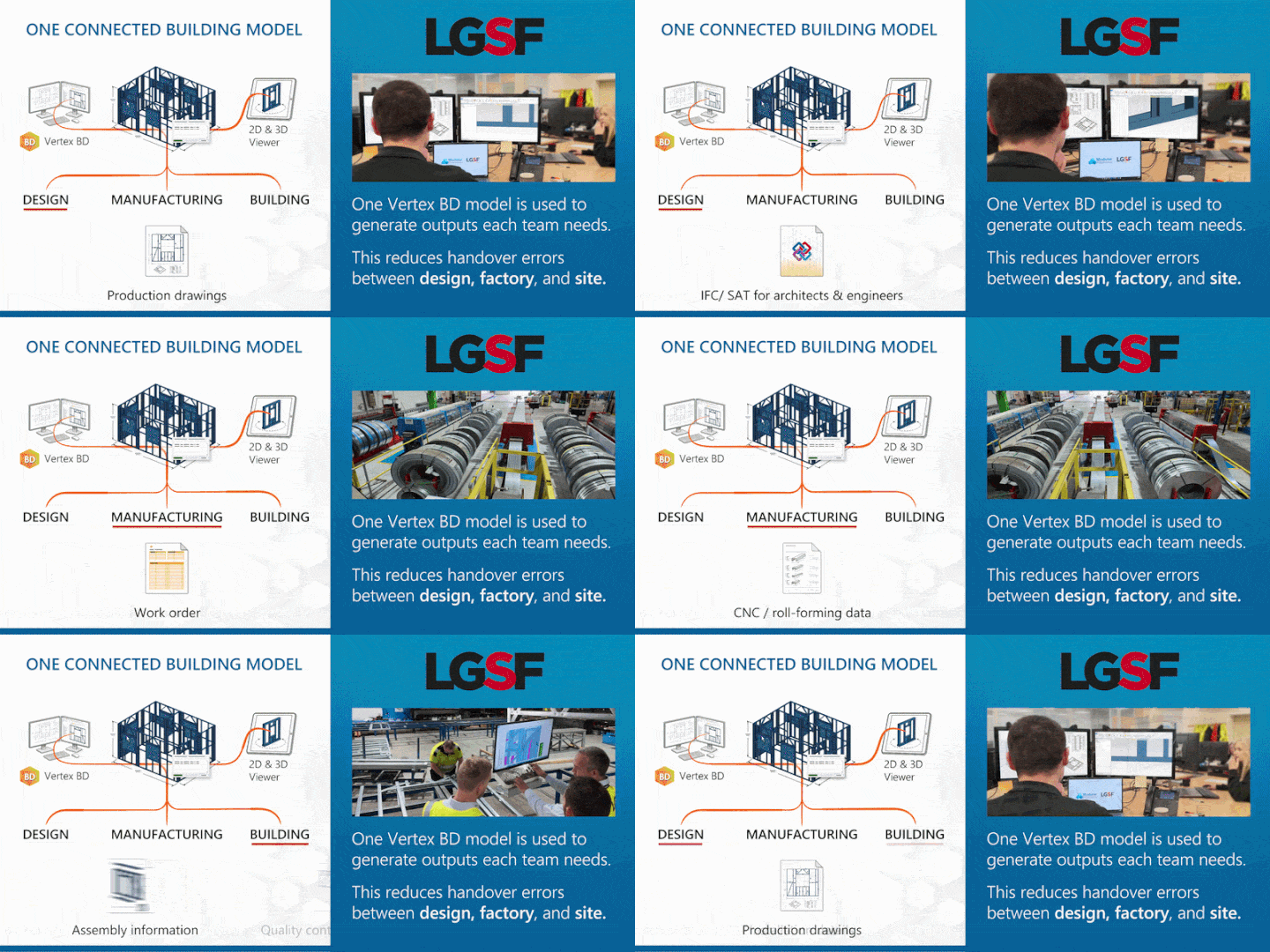
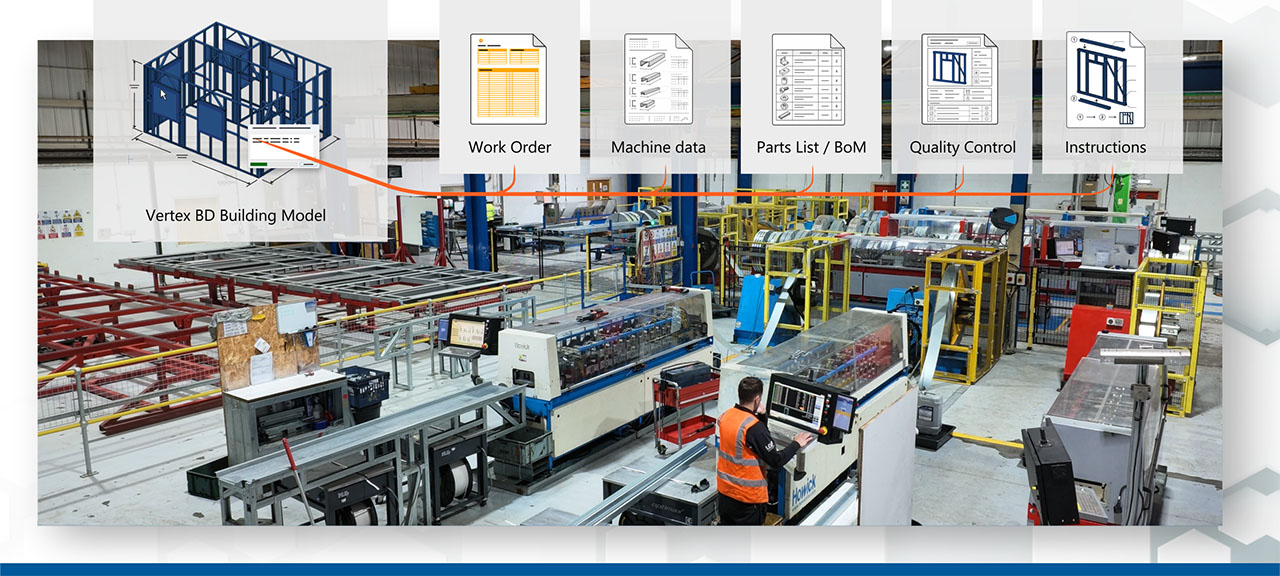
Vertex BD is becoming more production critical and integrated at LGSF as their design-to-production workflow is being developed further. Vertex BD outputs include:
Design outputs
- Production drawings
- General arrangement drawings
- IFC/SAT for architects & engineers
Manufacturing outputs
- Work order
- Parts lists / bill of materials
- CNC / roll-forming data
Production outputs
- Assembly information
- Quality control documents
- Installation details
For LGSF, these outputs are part of the value chain that protects quality throughout, from pricing and approval through manufacturing, assembly, and installation. Keeping human error to a minimum is critical. “It takes years to build a good reputation while it can take seconds to destroy it” Ian notes.
Vertex BD is used by LGSF in pricing and estimating by “quickly and accurately mocking in some volumes and steel quantities” and for passing model information as an IFC or a SAT file to the clients and structural engineers for comments before commencing detailed design.
In detailing, repetitive work is reduced by basing designs on Vertex BD templates containing LGSF standard details. Previous projects can also be reused where relevant, helping the team speed up work without starting from scratch. Modern Smart Models, which for example allows you to update identical bathroom designs across a big model automatically, as well as older tried and tested features are used to speed things up.
“To give Light Gauge the benefits of being developed by us, we need to be able to customize the profiles, rules and outputs for our way of manufacturing.”
For Ian, customization is not a nice extra. It is part of how LGSF removes bottlenecks from its production workflow. Whenever he or his team can identify a bottleneck in design, they will have a conversation about whether to invest in a custom Vertex BD tool.
“New tools developed for our specific design-to-production workflow have generally paid off and have been done in a swift and concise manner by Vertex.”
But understanding what your organization needs doesn’t happen by sitting behind a desk. Ian has made sure his designers do downstream work as well, so they have first-hand experience manufacturing the material and then assembling panels in the factory.
When a detailer understands the factory environment, they also understand what buildability means and what is required from assembly drawings. With practical build experience, Vertex BD’s tools, and the 3D environment, designers can check the product from the necessary angles, consider tool access and safety, and think through the order of work before the panel reaches assembly.
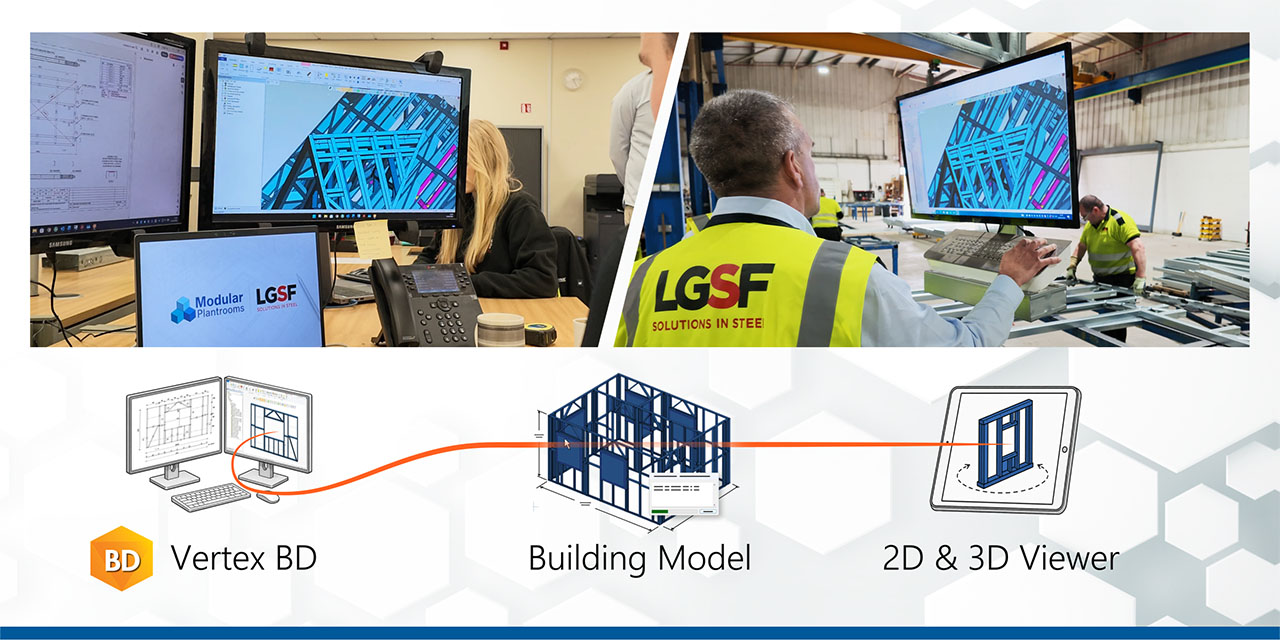
In assembly, Vertex Viewer gives the team another way to check the model, rotate details, and understand connections before or during production work.
STANDARDIZING COMPLEXITY IN COLD-FORMED STEEL
LGSF has never shied away from complexity, unless it’s something, as Ian puts it, “completely ridiculous.” Within their second year they produced angled panels for 20m internal diameter biomass vats with conical tops. “Connections between those were…” There’s a slight pause while Ian looks for a civil word to end his sentence, “…interesting.” He smiles while we all know the weight that word carries.
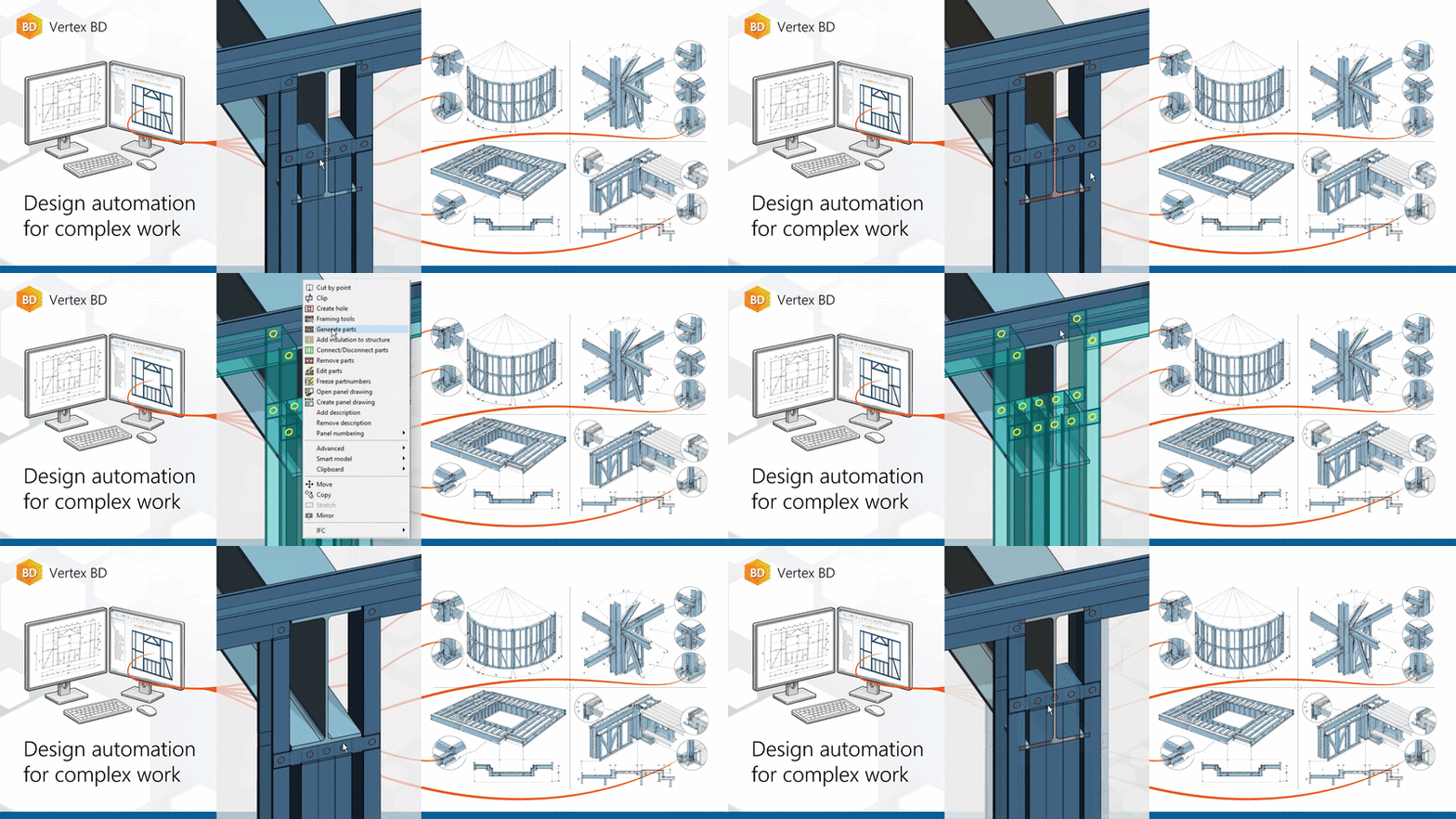
LGSF has worked together with Vertex to build tools that automate repetitive tasks, so detailers can focus on solving design problems.
From the start, LGSF worked on decks, external panelling, custom corners, and dropped areas for hot tubs — the kind of work that might traditionally be solved on site with timber, measuring tape, and chainsaws. Turning that kind of complexity into a manufacturable CFS product required LGSF to understand buildability in detail and translate it into repeatable factory processes. These early jobs required around 1000 meters of steel roll. LGSF has grown since and Ian now orders 500 tons plus of material on a regular basis. The advantages of Cold-Formed Steel and LGSF’s way of working quickly became apparent to the building industry.
“We had a massive contract where we were consistently producing 550 tons of steel product per month in Light Gauge, which was probably the biggest output of a panelized system in Europe.”
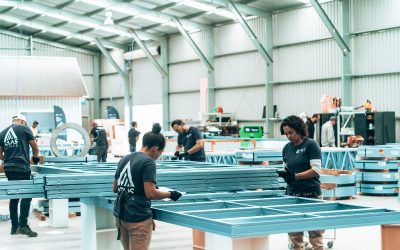
At that pace, LGSF made four and a half semi-detached houses per day. The walls, and floors, were panelized in LGSF’s factory and transported to the client, with a further LGSF team integrated into the client’s production line to assemble large-format floor and ceilings panels.
Some client need at little more support, these clients can take advantage of our volumizing service. These tend to be larger modules where mechanical lifting is the key to the operation.
“We can lift five-meter-wide floor and roof panels, generally up to 15m long in the factory, bring in the walls, pop in some bolts… and there’s the module. The client is receiving a product they can start boarding or working on as soon as it is delivered to their facility.”
High-volume production also made the full workflow visible.
“When you run that amount of product, you can quickly identify the shortcomings in any part of the workflow: whether its detailing, liaison between key stakeholders or the assembly and delivery of the product itself, you quickly understand where your key challenges lie”.
Ian has made sure they can serve a broad range of needs with Cold-Formed Steel.
“We want to supply stick product. We want to supply panelized. We want to supply volumetric because it gives me a full market. If one drops off, we’re still able to do the other thing.”
Knowing exactly where LGSF’s product fits into the client’s process helps the team design for the full workflow: from planning and manufacturing to transport, assembly, and installation.
“We’ve done some very weird and wonderful things with Light Gauge and developed the design-to-production tooling alongside that.”
WHY LGSF DOES NOT COMPETE ON PRICE ALONE
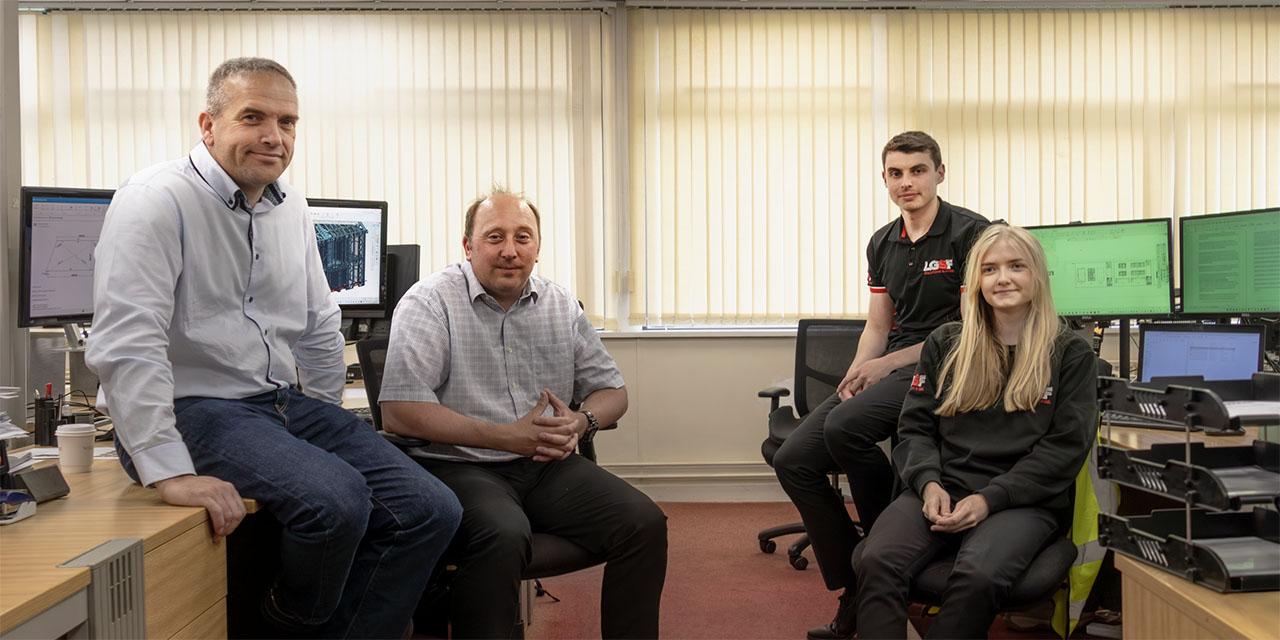
From left to right: LGSF Technical Director Ian Cade, Draughting Manager Daley Wharton, Senior Draughtsman at LGSF Sam Pallant and Apprentice draughtsperson Erin Wray.
“Vertex BD is ingrained in our business. If a feature is not pre-built into the software there’s either support around it or then we investigate customization. We like to provide the best product we can, and we work together with Vertex to achieve that.”
LGSF customers enjoy high attention to detail, responsive service and quality products. Ian and his team have built their design-to-production workflow so that, when needed, a panel can be manufactured, assembled, and mobilized out of the factory in less than 24 hours. Their quickest response time has been close to ten minutes.
“I will openly admit that I will not be the cheapest source of supply. But we will save you in the time you’re fixing unforeseen problems or from the speed of how you can put an LGSF building together, because we look at the minutia from the start. The orders come in very quickly when clients experience our services and products.”
For companies investing in Cold-Formed Steel, LGSF’s experience shows that the machine is only one part of the operation. Growth depends on how well design data, production outputs, assembly knowledge, and site requirements work together. LGSF’s story shows what becomes possible with a connected model-based workflow.
LGSF and Vertex Systems have worked together for over 20 years in the Cold-Formed Steel business.
Related stories
How to Scale a CFS Business from Design to Production
How to Scale a Cold-Formed Steel Business from Design to ProductionLight Gauge / Cold-Formed Steel manufacturing has enormous potential for industrialized construction. But adding roll-forming capacity alone does not create a scalable operation. The aim is to increase...
Vertex BD supports Steelcraft Group’s commitment to delivering precision house framing for Australia’s builders
Vertex BD supports Steelcraft Group’s commitment to delivering precision house framing for Australia’s builders integrated design technology and independent verification underpin one of Queensland’s most trusted framing operations.
Atlas Frames’ path from student housing to mastery in light gauge steel framing with Vertex BD
Atlas Frames’ path from student housing to mastery in light gauge steel framing with Vertex BD In collaboration with Vertex BD, Atlas Frames is carving a niche in efficient living spaces, marking a new direction for the business.